Panels have finally taken shape to form the main framework... the installation's coming on steadily! Drawings to follow :)
Latest developments:
Showing posts with label stills. Show all posts
Tuesday, 21 January 2014
Saturday, 14 December 2013
Design Development // Interim review 12/12/13
“What''s a crit without a technical glitch?”
Despite the very awkward (walking to another room to fix the) technical fault regarding the video to projector setup during my presentation (!) the day was informative and educational to say the least!
The design process is again leading to new thoughts and developments, given some expert advice from the 'Usual Suspects' and the two guests speakers from the AA and UCL.
Main questions posed:
Is the framework over engineered? could it be constructed more simply and still enclose an immersive experience?
What message does the riot information projection convey? can it be refined?
Design Development:
Presentation sheets:
Experiment set-up No: 5:
Framework construction details:
The Video Projection:
Original test reel which was displayed during the presentation (Video: Tina Zacharia)
Can be found at: http://www.youtube.com/watch?v=3L-jbI9Zlh0&feature=youtu.be
![]() |
| Visual feedback loop x Video information projection (Presentation: Tina Zacharia) |
![]() |
| Riot glossary: building the narrative (Presentation: Tina Zacharia) |
| The Crit Panel: left to right: Gabor Stark, Sam McElhinney, Abigail Batchelor (AA), Dr. Sophia Psarra (UCL) (photo: Tina Zacharia) |
Aiming to capture the essence of human interaction through an ephemeral collection of imagery via a visual feedback loop posed the questions of execution and structural simplification.
Labels:
Cantarch,
design development,
Diagrams,
Documentation,
information,
installation,
layers,
magical fabrications,
movie reel,
Research,
riot information,
Short film,
stills,
surveillance installation,
UCA
Sunday, 1 December 2013
Designing the projective screen // Material testing
Following the preliminary, one layer experimental studies into clear / translucent materials for surface projection; recording levels of Light permeability, Reflectance, Tactile material quality, results have shown that clear / opaque plastic sheeting material samples were highly reflective which visibly diminished the clarity of the projected image. The stripped samples tested favourably added to the distorted effect but due to their lightweight and thin nature, effective image stabilisation could not be achieved.
A selection of the material samples which were tested together with their results may be found below:
| Transparent polyethylene sheeting |
| Fine woven cotton scrim |
| Mid grade woven cotton scrim |
| Interaction with Rough grade cotton scrim |
| Rear view through projective surface to wall |
Friday, 15 November 2013
Riot Iconography - "Layering the loop"
| Coke? Riot icons - feeding visually stimulating imagery within the loop |
Researching into how visual stimuli (namely moving textual and flashing imagery) respond the feedback loop, I set up a sample reel in order to test various scenarios, alongside adapted setup (i.e height / angle)
Resultant stills are below:
1/ No Camera rotation
.png)
.png)
.png)
2/ Camera rotation - 90 degrees
3/ Projector displacement - 45 degrees
.png)
.png)
.png)
.png)
.png)
4/ Image manipulation (through player)
| Icon Layer stills (Photos: Tina Zacharia) |
Monday, 11 November 2013
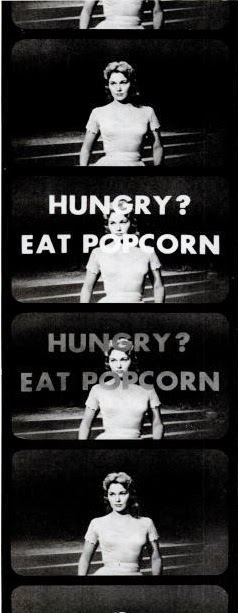
Hungry? EAT POPCORN
The birth of subliminal advertising as we know it dates to 1957 when a market researcher named James Vicary inserted the words "Eat Popcorn" and "Drink Coca-Cola" into a movie.
The words appeared for a single frame, allegedly long enough for the subconscious to pick up, but too short for the viewer to be aware of it. The subliminal ads supposedly created an 18.1% increase in Coke sales and a 57.8% increase in popcorn sales.
Vicary's results turned out to be a hoax. But more recent experiments have shown that subliminal messages actually can affect behavior in small ways.
A Harvard study from 1999 employed a similar method to Vicary's -- subjects played a computer game in which a series of words flashed before them for a few thousandths of a second. One set got positive words like "wise," "astute," and "accomplished." The other set got words like "senile," "dependent," and "diseased."
Despite the fact that these words flashed far too quickly to be consciously perceived, those who received positive words exited the room significantly faster than those who got negative words.
However, William Peter Blatty, author of The Exorcist, prominently spoke out against subliminals when the movie adaptation of his book came under fire for including allegedly subliminal messaging. He said, "There are no subliminal images. If you can see it, it's not subliminal."
So do advertisers consciously choose to include subliminal messages in their ads? Can they harness subliminal power to associate their products with sex and power? If so, does it actually affect a consumer's buying decisions?
http://www.businessinsider.com/subliminal-ads-2011-5
Friday, 8 November 2013
Subscribe to:
Posts (Atom)