|
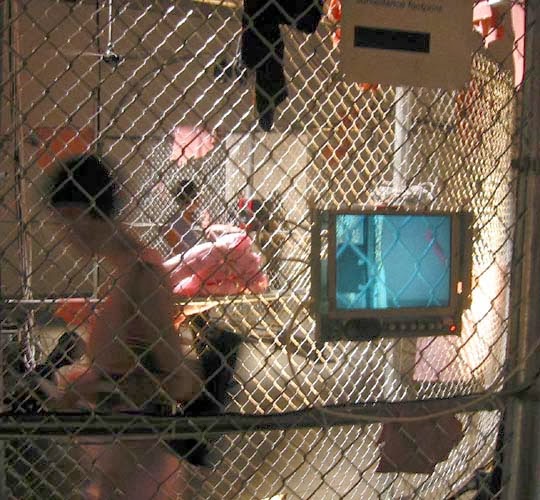
| Julia Scher, Recovery Agent (R.A.), 1987 |
Performance with security and surveillance equipment. One of the first installation presences animating the world of security sales with a mad-cap,
jungle-like structure.
"I originally saw surveillance in terms of looking at landscape, because indeed there was the landscape through the lens or eye of a camera rather than my own eye. I don't, however, agree that space is the battleground. More insidious and less visible to the human eye is identity, created through multiple data bases and hierarchies imposed and created without laws or the knowledge of those being judged. These virtual spaces are far more interesting for me and far more dangerous. At least you can see actual space. Virtual space is another ruse, because our virtual identities have to be created before we can pass through a virtual space. What kinds of hierarchies are going to be employed to keep us in or out of those virtual spaces? I can penetrate those walls without being a physical presence. I'm interested in the extremity of this battleground.
I have always found my best work to be "encounter work" — looking at the phenomenological world one enters. An experiential aesthetic interest. It continues here, in digital, programmable, plastic, and sensory testing areas. I have always thrived in initiating an impossible project (an invisible one, a ridiculous one) here in real new worlds (still smooth, new, and dependent new worlds) where visitors can deal with their own flexible script. It's not museum walk-through alone. It's cramming methodological reiterative tour guides — alongside on-your-own, have-what-you-will poem gardens. . . .
Surveillance space has been a metaphor for controlled space, controlled life. Electronic control devices in their earlier applications were placed at the edge of lived space (you would see the guard at the edge of the building underground, or hidden away). Now as surveillance and security (and kid scrutiny) has become more foregrounded in architecture, television, transportation, etc., its unmasking or its display has been FUN FOR ARCHITECTS.
To unmask (and deconstruct) was a way to criticize, undo, reveal, and be revolutionary. Now, it's part of an aesthetic of exposed foundations, a deconstruction of architecture. No longer on the edge, or behind the camera's hidden-eye security, THE APPARATUS comes out of its shell and acts as a prism and white-hot calculator in space"
-01.png)
-02.png)
-11.png)
-09.png)
-03.png)
-04.png)
-07.png)
-08.png)
-10.png)
-05.png)
-06.png)