Friday, 15 November 2013

Riot Iconography - "Layering the loop"


Coke? Riot icons - feeding visually stimulating imagery within the loop

Researching into how visual stimuli (namely moving textual and flashing imagery) respond the feedback loop, I set up a sample reel in order to test various scenarios, alongside adapted setup (i.e height / angle)


Resultant stills are below:

1/ No Camera rotation


2/ Camera rotation - 90 degrees


3/ Projector displacement - 45 degrees


4/ Image manipulation (through player)

Icon Layer stills (Photos: Tina Zacharia)

Monday, 11 November 2013

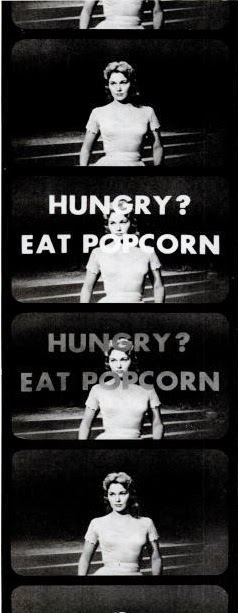
Hungry? EAT POPCORN


The birth of subliminal advertising as we know it dates to 1957 when a market researcher named James Vicary inserted the words "Eat Popcorn" and "Drink Coca-Cola" into a movie.
The words appeared for a single frame, allegedly long enough for the subconscious to pick up, but too short for the viewer to be aware of it. The subliminal ads supposedly created an 18.1% increase in Coke sales and a 57.8% increase in popcorn sales.
Vicary's results turned out to be a hoax. But more recent experiments have shown that subliminal messages actually can affect behavior in small ways.
A Harvard study from 1999 employed a similar method to Vicary's -- subjects played a computer game in which a series of words flashed before them for a few thousandths of a second. One set got positive words like "wise," "astute," and "accomplished." The other set got words like "senile," "dependent," and "diseased."
Despite the fact that these words flashed far too quickly to be consciously perceived, those who received positive words exited the room significantly faster than those who got negative words.
However, William Peter Blatty, author of The Exorcist, prominently spoke out against subliminals when the movie adaptation of his book came under fire for including allegedly subliminal messaging. He said, "There are no subliminal images. If you can see it, it's not subliminal."
So do advertisers consciously choose to include subliminal messages in their ads? Can they harness subliminal power to associate their products with sex and power? If so, does it actually affect a consumer's buying decisions?
http://www.businessinsider.com/subliminal-ads-2011-5

Sunday, 10 November 2013

"Who are you?" Digital titles


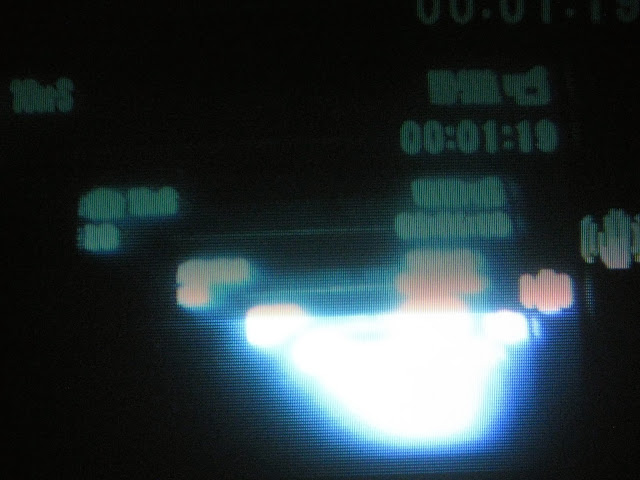
 Feeding digital titles into the feedback loop; exploration into the beginnings of subliminal messaging (using digital cameras existing inbuilt title / information layer) with intention to overlay into a double loop set up.

To view video at full size, please visit:
http://www.youtube.com/watch?v=tvOsf8Z3K_s

Digital Information loop stills II

Title stills from video (All photos: Tina Zacharia)

Friday, 8 November 2013

Digital Information loop stills I

                                                                            
                                                                              Data layers (photos: Tina Zacharia)

Wednesday, 6 November 2013

Transformations in illusion

After reading “About Magic,” by Michael Benedikt, I came across the poetic works of Solano Benitez, WHOSE DESIGNS ENCAPSULATE THE VERY ESSENCE restorative magic THROUGH reconstituted materials. intrigued by his sensual use of materiality encouraging dialogue, Piribebuy grave installation (in memory of his father) plays upon the manipulation of space via mirrored screens; multiplication of images with every movement; bending, sitting and walking through. 


"...in the mirror i'm "there" in front, outside of myself, living in another dimension that equals me anything else, or that I may dwell in another world than inside, on a basis of equality and simultaneity in the mirror may have the machine that can afford to live in another way with our loved ... absent loved ones, because the obscenity of death tore them from our side ... love those who are impossible, because we never find neither the space nor the time to enable them to exist ..."

image references:
 http://rolu.terapad.com/index.cfm?fa=contentNews.newsDetails&newsID=981513&from=archive

Magical Realism


"Magic serves TO unsettle our certainties about how things work or should look, Replacing monotony with marvel, magic— even magic that we know has a rational explanation—lets a light shine from the deed or
thing that makes us feel oddly fortunate to witness it, to be there, in its presence"

“About Magic,” Preface to CENTER 16: Latitudes (2011) by Michael Benedikt    http://www.mbenedikt.com/lats-preface-about-magic.pdf