Photos (Tina Zacharia)
Wednesday, 11 December 2013
Friday, 6 December 2013
Tuesday, 3 December 2013
Layering projections
Original Video (Tina Zacharia) also found at:
Following my prior studies and experimentation with varied materials, the most successful in transmitting light through layers has proven to be the medium gauze linen; excellent in allowing for fluid movement as well as the ability to be pulled taunt. The above video illustrates the diffusion of image projection through the 3 hand made screens.
Sunday, 1 December 2013
Designing the projective screen // Material testing
Following the preliminary, one layer experimental studies into clear / translucent materials for surface projection; recording levels of Light permeability, Reflectance, Tactile material quality, results have shown that clear / opaque plastic sheeting material samples were highly reflective which visibly diminished the clarity of the projected image. The stripped samples tested favourably added to the distorted effect but due to their lightweight and thin nature, effective image stabilisation could not be achieved.
A selection of the material samples which were tested together with their results may be found below:
| Transparent polyethylene sheeting |
| Fine woven cotton scrim |
| Mid grade woven cotton scrim |
| Interaction with Rough grade cotton scrim |
| Rear view through projective surface to wall |
Monday, 25 November 2013
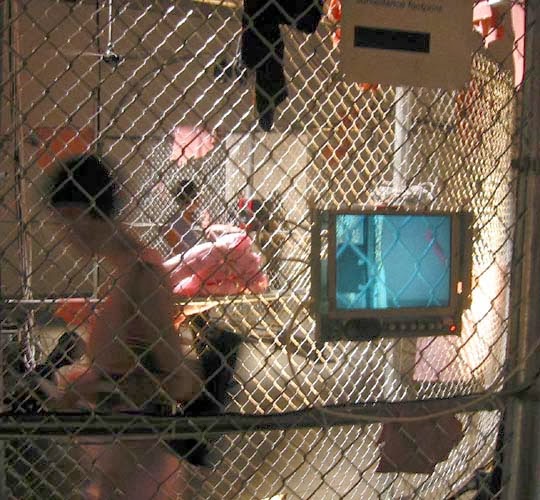
Surveillance // Julia Scher
![]() |
| Julia Scher, Recovery Agent (R.A.), 1987 |
Performance with security and surveillance equipment. One of the first installation presences animating the world of security sales with a mad-cap,
jungle-like structure.
"I originally saw surveillance in terms of looking at landscape, because indeed there was the landscape through the lens or eye of a camera rather than my own eye. I don't, however, agree that space is the battleground. More insidious and less visible to the human eye is identity, created through multiple data bases and hierarchies imposed and created without laws or the knowledge of those being judged. These virtual spaces are far more interesting for me and far more dangerous. At least you can see actual space. Virtual space is another ruse, because our virtual identities have to be created before we can pass through a virtual space. What kinds of hierarchies are going to be employed to keep us in or out of those virtual spaces? I can penetrate those walls without being a physical presence. I'm interested in the extremity of this battleground.
I have always found my best work to be "encounter work" — looking at the phenomenological world one enters. An experiential aesthetic interest. It continues here, in digital, programmable, plastic, and sensory testing areas. I have always thrived in initiating an impossible project (an invisible one, a ridiculous one) here in real new worlds (still smooth, new, and dependent new worlds) where visitors can deal with their own flexible script. It's not museum walk-through alone. It's cramming methodological reiterative tour guides — alongside on-your-own, have-what-you-will poem gardens. . . .
Surveillance space has been a metaphor for controlled space, controlled life. Electronic control devices in their earlier applications were placed at the edge of lived space (you would see the guard at the edge of the building underground, or hidden away). Now as surveillance and security (and kid scrutiny) has become more foregrounded in architecture, television, transportation, etc., its unmasking or its display has been FUN FOR ARCHITECTS.
To unmask (and deconstruct) was a way to criticize, undo, reveal, and be revolutionary. Now, it's part of an aesthetic of exposed foundations, a deconstruction of architecture. No longer on the edge, or behind the camera's hidden-eye security, THE APPARATUS comes out of its shell and acts as a prism and white-hot calculator in space"
Excerpted from "Julia Scher interviewed by Paul D. Miller," Artbyte, October-November 1998, 42-47, and from an email interview with Julia Scher by Bruce Jenkins, Film/Video Curator at the Walker Art Center.
Source: http://www.sfmoma.org/exhib_events/exhibitions/details/espace_scher#ixzz2lhKQeKjw
San Francisco Museum of Modern Art
Source: http://www.sfmoma.org/exhib_events/exhibitions/details/espace_scher#ixzz2lhKQeKjw
San Francisco Museum of Modern Art
Friday, 22 November 2013
Cildo Meireles: Fontes (Fountains/Sources)
…When a work of art kidnaps you for a fraction of a second, it takes you to another time …I realized that, of all the movements that I had studied, conceptual art was the only one that didn’t use any of the things linked to art: inks, brushes, canvases. It could be made from anything. It gave complete freedom. It is the most democratic way to produce art that has come up. That is something that deserves credit.
http://www.youtube.com/watch?v=D0kxLG1chNU#t=49
Emerging design...update!
'Social Theatre' rig
This immersive, theatrical installation is designed to explore and
expand upon the ways in which space can be used to resonate with the human
experience. The installation begins to ask if it is possible to exist within a
surveillance space. How do we react to such a situation and does it change our
perception of space when directly confronted with the surveillance device.
The suspended strips provide for the transitional phase between external
space and internal surveillance space; encouraging a polarised encounter
between excitement and anxiety. The carefully placed set of strip components allow
for a modest level of personal control, the potential for discovery and
exploration as well as a sense of precariousness (i.e. danger)
The loop/ video projection creates a series of intersecting occasions
between the participant and the set-up which ignites a range of reciprocal / sequential
movements. The participant enters and constructs a personal experience; of
power and control. The participant’s enters a constantly shifting dialogue;
each interaction will in turn have a mutual reaction – video projector output
is directly affected by the input and vice versa. Information provided by the
video, the loop and the participant is not just passed but mutually constructed.
The use of scaffolding emphasises the designs temporality, providing a
platform for social and political exchange / transformation.


Subscribe to:
Posts (Atom)